Professor Navindra Seeram, Ph.D., has been studying the health benefits of maple since 2009. His research focuses on investigating medicinal plants and their derived natural products for preventive and therapeutic effects against chronic human diseases. He has studied the health benefits of several antioxidant and polyphenol-rich foods including berries, tart cherries, and pomegranates. In 2009, he added maple to his list of plants with potential health benefits.
Today, Professor Seeram and his team of scientists at the College of Pharmacy at University of Rhode Island have conducted extensive research on pure maple; specifically, the phytonutrients it contains. Seeram and team have found more than 67 bioactive natural plant compounds with potential health benefits and published several major scientific studies, confirming maple is a ‘’smarter sweetener.’’ Some of these studies were presented in 2017 and again in 2019 at the annual spring meetings of the American Chemical Society (ACS), the largest scientific society in the world. Meanwhile, negative news continues about added processed and refined sugars, as well as chemical sweeteners.
Untapped Potential
A sustainable North American agricultural crop, pure maple is more than just delicious. Pure maple is a “smarter sweetener” that not only provides a natural alternative to processed sugar and chemical sweeteners, but also several potential health benefits. Maple is a crop that cannot be outsourced, and its beneficial food products require minimal processing increasing the economic potential of each production region.
Maple House, Coombs Maple. Credit: Russell French Photography.
At the heart of the maple country, University of Rhode Island is uniquely positioned to research maple and is the foremost institution on maple health benefits. For over a decade, we have researched maple’s unique compositional chemistry containing minerals, vitamins, amino acids and more than 67 bioactive natural plant compounds with potential health benefits. Our laboratory based findings have shown that maple compounds may help stabilize blood glucose levels, fight inflammation and help fight wrinkles.
Pure maple syrup is made by concentrating the slightly sweet sap of the Acersaccharum or sugar maple tree through a process of heating and evaporation. The sap is collected by tapping the trees with small, tree-friendly spouts. The sap is then gathered and boiled in an evaporator. When the finished syrup is drawn off the pan, it is filtered, and packaged. Pure maple is naturally sweet, with nothing added.
Nature is the best chemist, and maple syrup is a super food when it comes to the number and variety of beneficial compounds it contains. It’s important to note that we found in our laboratory research that several of these compounds possess anti-oxidant and anti-inflammatory properties, which may have beneficial effects against certain cancers, diabetes, bacterial illnesses, and some neurodegenerative diseases, such as Alzheimer’s. Few, if any, other natural sweeteners have this anti-oxidant cocktail of beneficial compounds. Maple has some of the beneficial compounds that are found in berries, some that are found in tea and some that are found in flaxseed. Only pure maple contains this unique cocktail of substances with potential health benefits.
Specifically, over the past decade, our research has focused on identifying bioactive plant compounds (known as phytochemicals or phytonutrients) and evaluating the biological effects of maple syrup, maple water (i.e. maple sap), and maple plant parts and their derived extracts. To date, there are several published in vivo studies (in animal models) and several in vitro studies (in cells and laboratory based assays) that support the positive biological effects of maple syrup. Although maple syrup is a newcomer to the functional food arena, this research has catapulted the natural sweetener into this category. However, maple faces challenges given the negative connotations associated with added sugars and excessive sugar consumption. Therefore, rigorous study designs and careful and responsible dissemination of research findings will be necessary to position (and keep) maple syrup in the functional foods category so that it can carve its own niche among other sweeteners and healthy plant foods.
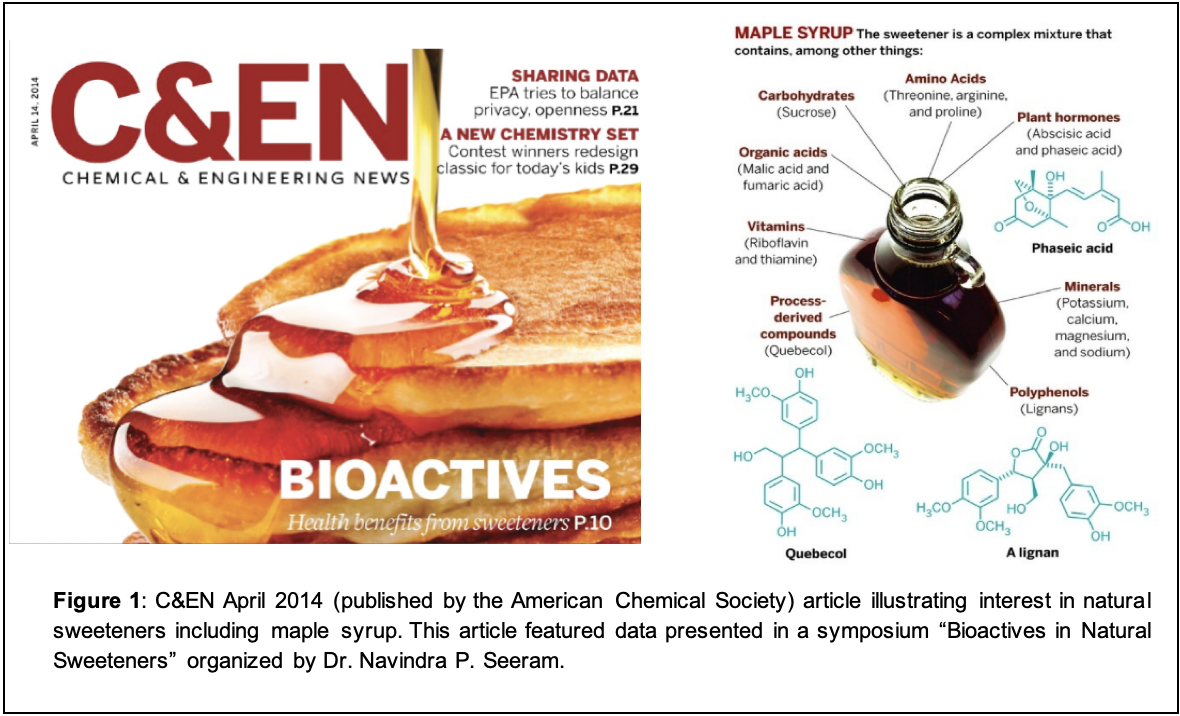
Maple syrup is a unique natural sweetener. It easily contains over 100 different substances including mono-and disaccharides (primarily as sucrose), complex sugars (i.e. oligosaccharides), minerals, amino acids, organic acids, phytohormones, vitamins, and phytochemicals. It is this latter group (i.e. phytochemicals) that has been the research focus of my laboratory, and towards this end, we have isolated and identified several phytochemicals in maple syrup. Interestingly, maple syrup contains a diverse cocktail of different chemical sub-classes of plant compounds (known as polyphenols or phenolics) which are also found in several other healthy plant foods including flax, tea, berries, and red wine. Obviously these molecules are all found in one ‘sweet’ package and it is remarkable that many compounds which naturally occur in maple sap survive the concentration process to persist in maple syrup and co-exist along with others which are formed during processing.
In summary, the “triple whammy” of unique chemical composition of macronutrients, micronutrients, and phytochemicals in maple syrup (see Figure 1), in combination with their promising biological activities, supports its functional food applications. However, remember to ‘drizzle and don’t guzzle’.
Note: The views and opinions expressed here are those of the author(s) and contributor(s) and do not necessarily reflect those of the publisher and editors of WholeFoods Magazine.


 RSS
RSS



 Related: Whole Foods Market Releases Top 10 Food Trends for 2020